
In real estate, opening is only the beginning. Belonging takes longer.
A project can arrive with capital, ambition, and sound commercial logic. It can fill up, perform well, and look convincing on paper. But in a place like Obor, that is not enough, since a neighborhood with its own memory does not make room for a new arrival overnight. It waits to see whether the project understands where it has landed, whether it serves more than itself, and whether it adds something lasting to the life around it.
That is why Veranda Mall’s first decade matters. Not simply because ten years is a milestone, but because time has made its role in Obor clearer. After nearly ten years in Obor, Veranda is no longer just a retail destination next to an area long known as the capital’s commercial hub. It has become part of the neighborhood’s daily vocabulary: a place people use, return to, orient themselves by, and increasingly treat as their own.
“Our goal was for Veranda to become a cultural center and a meeting place for the people living in the Obor area, one with a long commercial history,” said Andrei Pogonaru. “We wanted to return to the idea of a meeting place, while bringing something modern, something complementary to what already existed.”
From its early years, Veranda Mall positioned itself as a proximity mall, rooted in the surrounding community rather than designed solely for occasional destination traffic. It was a subtle but important choice. In a district as distinctive as Obor, belonging could never come from scale alone. Over time, Veranda learned the neighborhood’s rhythm, invested in the area, and became a place people genuinely use.
That relationship began on ground that already carried its own memory. Veranda was built on the former Prodplast site, so the project did not appear on neutral land. It emerged from an industrial area and had to find a new role within a district that already knew itself well. Even its identity reflected that effort to connect old and new. The name “Veranda” was chosen to evoke a familiar, almost domestic space, while the logo reinterpreted the image of a traditional Romanian carpet, linking memory and modernity in a way that felt rooted rather than generic.
“Since opening in 2016, Veranda Mall has remained deeply connected to the Obor neighborhood,” said Andrei Pogonaru.“For us, the 10-year anniversary is not just a milestone, it’s a reminder that our mission has always been to grow with the community.”
Over the years, the mall treated the neighborhood not as branding scenery, but as a source of continuity. The book Oborul, ieri și azi, launched by Veranda at its five-year milestone, was one of the clearest gestures in that direction: a tribute to the area built from archive images, stories, and local memory.
More than a symbolic anniversary project, it was conceived as a genuine homage to Obor. In time, other similar projects followed, such as graffiti art added to the amphitheater and even a fashion collection, both inspired by the neighborhood’s eclectic nature. This positions Veranda not just as a business operating in the area, but as a participant in preserving and retelling part of its identity.
What followed was equally important. Beyond symbolism, Veranda Mall invested steadily and concretely in projects to improve local infrastructure. Around the mall, this meant public utility works, donated land, street widening, signalized crossings, sidewalks, and other interventions that improved access and circulation in one of Bucharest’s most intense urban areas.
That matters in a district like Obor because convenience is not abstract there. It is felt in safer crossings, smoother traffic, and streets that work better for the people who use them every day.
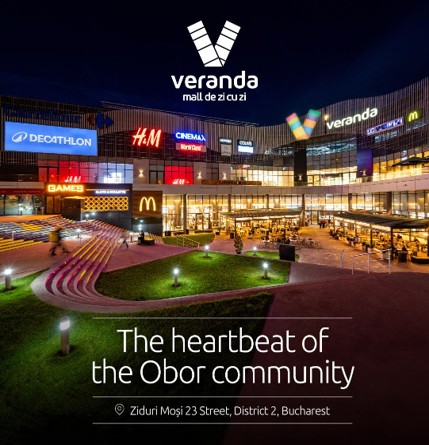
Veranda Mall had adapted its business model to ensure they stay relevant without abandoning its original role as a proximity mall. It refined its mix of retail, services, food, and entertainment to match what the area needed, not just what looked good on paper, while later investments brought new entertainment formats, upgraded public areas, and a renovated amphitheater designed as a genuine gathering point for the community.
“The mall has kept developing as we got to know the community better and better,” Andrei Pogonaru says. “Every year, we carry out market studies to identify the community’s needs and respond to them. But regardless of the modernization changes we make, we always keep the spirit of Obor in mind and, above all, keep the community at the center.”
Commercially, Veranda Mall has shown that scale alone is not enough. Over the years, it has maintained an occupancy rate of around 99% while refining a tenant mix shaped by local demand: essential retail, services, sport, entertainment, food, beauty, family-oriented brands, and practical everyday functions.
More recent additions, from international food operators to local concepts and expanded pet-friendly retail, show a project that continues to evolve with consumer behavior rather than simply defend an older formula. This ability to adjust without losing its character is one of the clearest signs of maturity.
Likewise, the launch of Obor 24/7, a community platform created as a digital extension of local dialogue, suggested a broader understanding of what a commercial project can be in the life of a city neighborhood. “Veranda Mall is more than a shopping center; it is a community hub,” Cristina Ciuclea says. “And Obor 24/7 is the natural extension of this role in the digital world.”
Just as importantly, Veranda has shown that a mall can play a broader role in an urban neighborhood. Its community work has not been limited to events designed to drive weekend traffic.
Over the years, Veranda Mall has supported charitable campaigns, donation drives, children’s educational events, local entrepreneurship, adoption events, and community-building initiatives that extended beyond commerce. These actions may seem peripheral if one looks at a mall strictly through the lens of asset performance. But they become central if one understands the project as Veranda increasingly does: as a platform for neighborhood life.
Even its more recent achievements, including sustainability investments and BREEAM certification, make the most sense in that context. At Veranda, these are not presented as abstract badges of modernization, but as part of a broader obligation to remain useful, responsible, and future facing in the place where it operates. “Our photovoltaic project is only the first step toward energy neutrality,” Andrei Pogonaru said. “We are committed to bringing value to the community and meeting the expectations of tenants and investors.”
Ten years on, Veranda Mall stands as an example of a real estate project that has reached maturity. In a market where many developments compete to appear new, Veranda’s greater achievement has been staying relevant. It has done so not by constantly reinventing itself for effect, but by growing with the neighborhood, paying attention to local needs, and accepting that in a place like Obor, legitimacy is earned gradually.
Veranda’s story is not really about age. It is about proof. Proof that a retail project can earn its place not through scale alone, but through attention, adaptation, and usefulness. In Obor, that is no small thing. Veranda did not become part of the neighborhood simply by arriving in it, but by learning how to belong there, and that may be the most fitting legacy of all.